


Shriv Returns in Spring
Updated: Apr 30
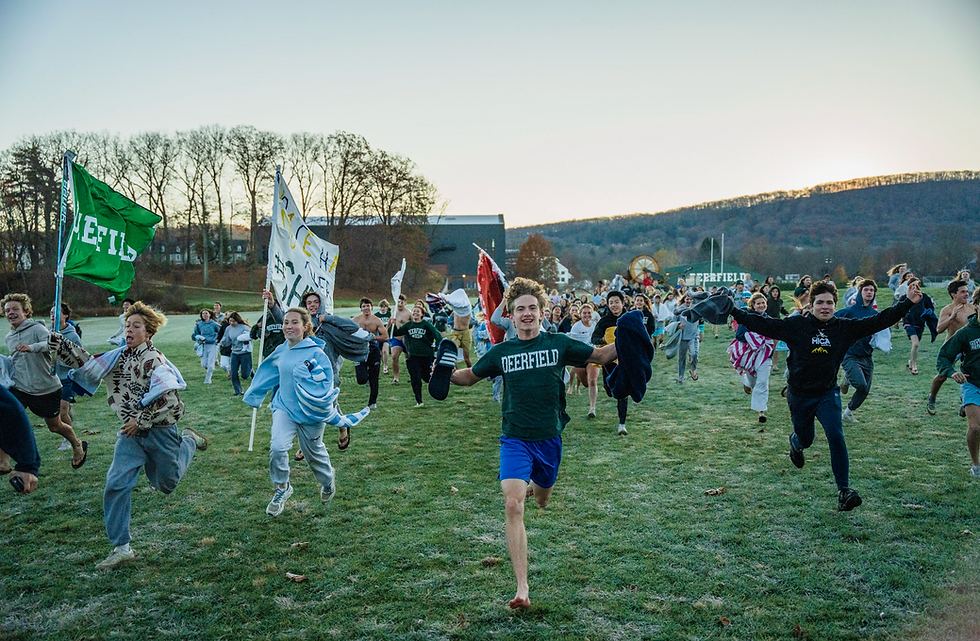
THIJS WITTINK/DEERFIELD SCROLL

August 1914: Sir Ernest Shackleton departed Plymouth, England, for the frozen unknown of the Antarctic.
April 2026: A shivering huddle of students at Deerfield Academy departed the Horse’s Head for the banks of the Riv.
To the untrained eye, the historical significance of these two voyages is indistinguishable. The sole point of divergence? Shackleton’s me
n were equipped with sturdy lifeboats, while we were left to navigate the sub-arctic abyss with nothing but a communal towel.
Both expeditions sought to overcome insurmountable odds; both fought the encroaching frost; and both, presumably, had many wet socks. Yet, while historians tirelessly laud the “Imperial Trans-Antarctic Expedition” for its bravery, they consistently overlook the sheer grit required for a
Deerfield student to traverse the frozen tundra of the Lower Fields.
Shackleton famously sailed roughly 800 miles across the Southern Ocean; we traveled roughly 800 yards. But to a teenager emerging from four hours of sleep and a caffeine-induced haze, those distances are identical. The endurance required to survive a Friday dip at 7 am at Deerfield, known as “Shriv,” is, to many, unimaginable.
This spring’s first Shriv was delayed two weeks due to river conditions, only heightening the anticipation for the first dip, which finally took place on April 10. Four-year veteran and Shriv Captain Cole Rorick ’26 noted that “The excitement was on another level, and everyone was exuding all the energy they’d been saving up.” The river, however, was not particularly sympathetic to the built-up enthusiasm. Shriv Captain Zander Auth ’26 reported that it clocked in at a brisk 41 degrees, colder than the air itself, due to what Jack Webb ‘27, a regular at the riverbanks, identified as “a lot of snow runoff.”
Rorick described the experience as “electric,” right before announcing that he had lost sensation in his toes. He offered a philosophical defense of this ordeal, “The river is cold, but because the community is so rich, it seems warmer.” A heartwarming sentiment. Medically speaking, however, community is not a recognized treatment for hypothermia.
Webb, meanwhile, processed the experience more poetically and poignantly: “The cold bit my toes and then bit my nose, but it wasn’t as bad because I ran in with my bros.” While most poets would have stopped there, he continued: “The cold made me feel awake. Waking up in the morning, it’s never fake. It’s so good to be back in the water for goodness sake, right after being on break.” For some, the river appears to be a source of inspiration. Newly selected Spring Shriv Captain Sophie Kamil ’26 concurred, noting that the adrenaline of a collective leap effectively “diminishes the cold,” which may also be called “collective delusion.”
When asked whether the warmer air makes spring dips easier, Rorick said it made it “less painful to leave the river.” Webb, on the other hand, was less satisfied, explaining that the lack of a thermal shock “didn’t make [him] feel good about himself,” to which Kamil simply replied: “Oh. I felt pretty good about myself.”
Some have more demanding responsibilities, like Shriv Captain Cece Cramer ’26, who is entrusted with the speaker. Explaining why senior-year Shrivs feel extra cold, Cramer said, “Having to carry the speaker in the cold months, the metal handle, my hands are freezing.” She takes the curation extremely seriously. “Every night before Shriv, I spend like half an hour in bed choosing the cue of songs.”
There are, of course, costs to devote to this immense. Cramer described developing a cold allergy of uncertain origin during the fall of her sophomore year, which she suspects may have been caused by her weekly dips. For several months, following each Shriv, she went to the health center covered in hives. Eventually, it went away, but in the meantime, she had to “wear like three pairs of socks to Shriv and crocs or boots over top,” along with socks on her hands. And yet, Cramer insists that “it's definitely worth it.”
When discussing student turnout, Rorick credited female participants with reshaping Shriv’s atmosphere, transforming what was once an all-boys tradition. “We’ve seen a decline in male attendance, and girls make it a very powerful place to be and a powerful thing to be a part of. The bigger the better; we have a lot more people because of all the girls showing up,” he explains.
Every great exhibition has its adversaries. For Shackleton, it was the crushing ice. For Shriv, it was the Student Bulletin. The administration officially forbade entry into the glacial waters, but students, rebellious by nature, emerged from the depths regardless. The authorities arrived. “Security pulled up and I thought I was done for,” Rorick recalled, but fortunately, they “just walked away.” Whether this is an institutional endorsement or capitulation remains unclear.
What is clear is that Shriv is thriving. As Webb eloquently yet not too logically put it: “The river’s cold, but the waters warm, and all the people make me wanna swarm.”